
Understand Level 2 asset categories
Distinguish CUI Assets, Security Protection Assets, Contractor Risk Managed Assets, Specialized Assets, and Out-of-Scope Assets under 32 CFR § 170.19.
How government contractors can modernize business operations while protecting Controlled Unclassified Information (CUI), through evidence-based scoping and a carefully governed separation of systems.
A practical framework for assessing asset categories, information flows, and the safeguards needed for a defensible CMMC boundary.


Not every system in a government contracting business necessarily belongs in the same CUI environment. But keeping CUI documents elsewhere does not, by itself, establish that a business platform is out of scope. Asset capabilities, security functions, connectivity, and actual information flows must be assessed.
Distinguish CUI Assets, Security Protection Assets, Contractor Risk Managed Assets, Specialized Assets, and Out-of-Scope Assets under 32 CFR § 170.19.
Review records, attachments, integrations, endpoints, identity systems, exports, logs, and the possibility of CUI entering routine workflows.
Consider whether neutral links can direct authorized users to customer-controlled CUI repositories without the business platform retrieving or processing protected content.
Identify the safeguards and evidence needed to support a defensible scoping decision, including AI ingestion, indexing, previews, and spillage handling.
A non-CUI business platform, a managed user endpoint, and a separately secured CUI repository can be considered as distinct logical zones. Any claimed separation must be demonstrated through technical controls and a customer-specific assessment.
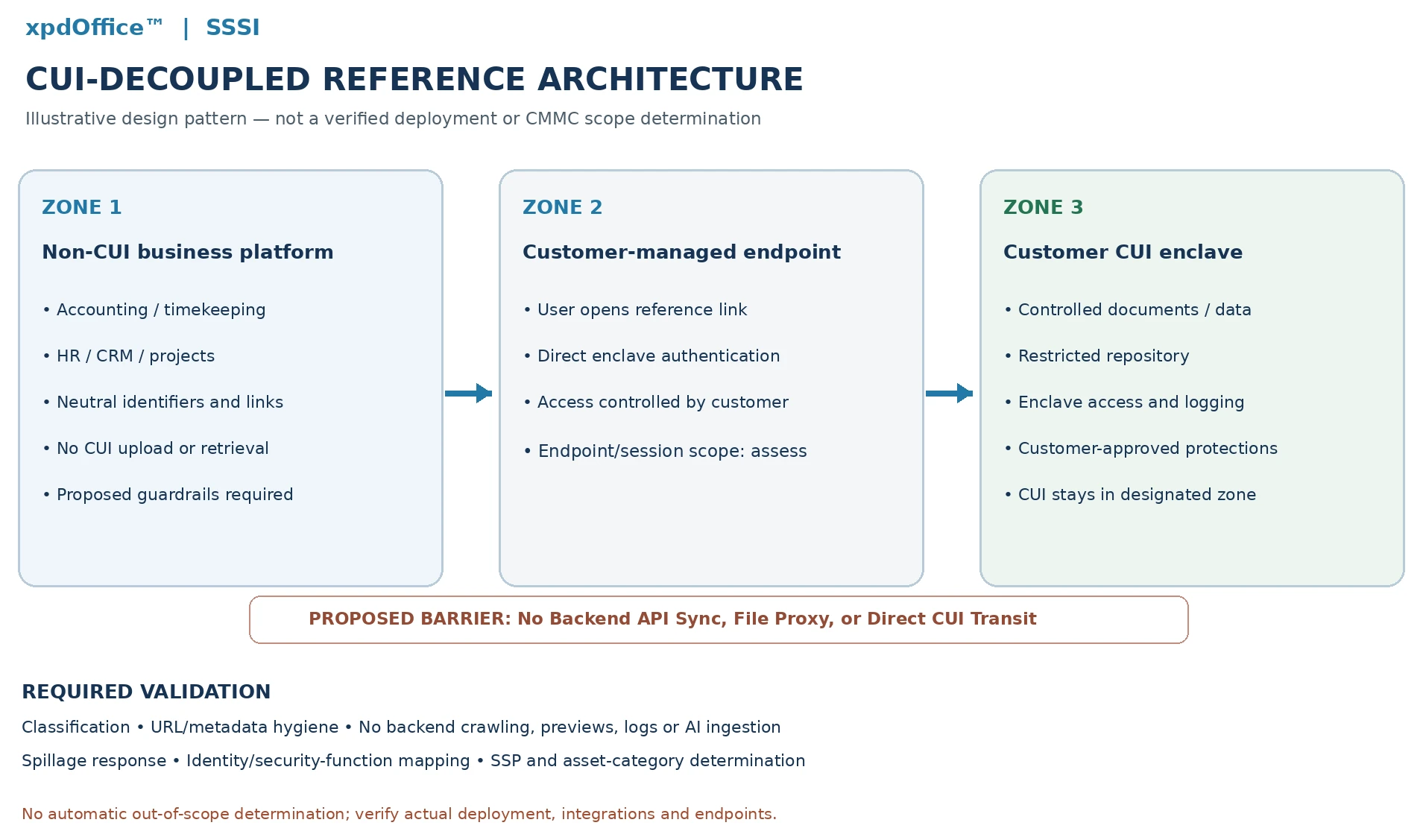
Figure 1. CUI-decoupled reference architecture (illustrative only; not a validated deployment or CMMC scoping determination).
Boundary clarification: “CUI stays in designated zone” means CUI remains within the assessed customer boundary, including authorized endpoints as applicable; no CUI enters the business platform. “No … logs” means no CUI content in business-platform logs; required security logging is retained.
Proposed barrier: no backend API synchronization, file proxying or direct CUI transit into the business platform. Verify with negative tests and documented data flows.
Read the asset-category discussion, architectural safeguards, and buyer due-diligence checklist.
Download the white paper (PDF)